
The Laundry Room Test: Could Your Family Reset It in 30 Minutes?
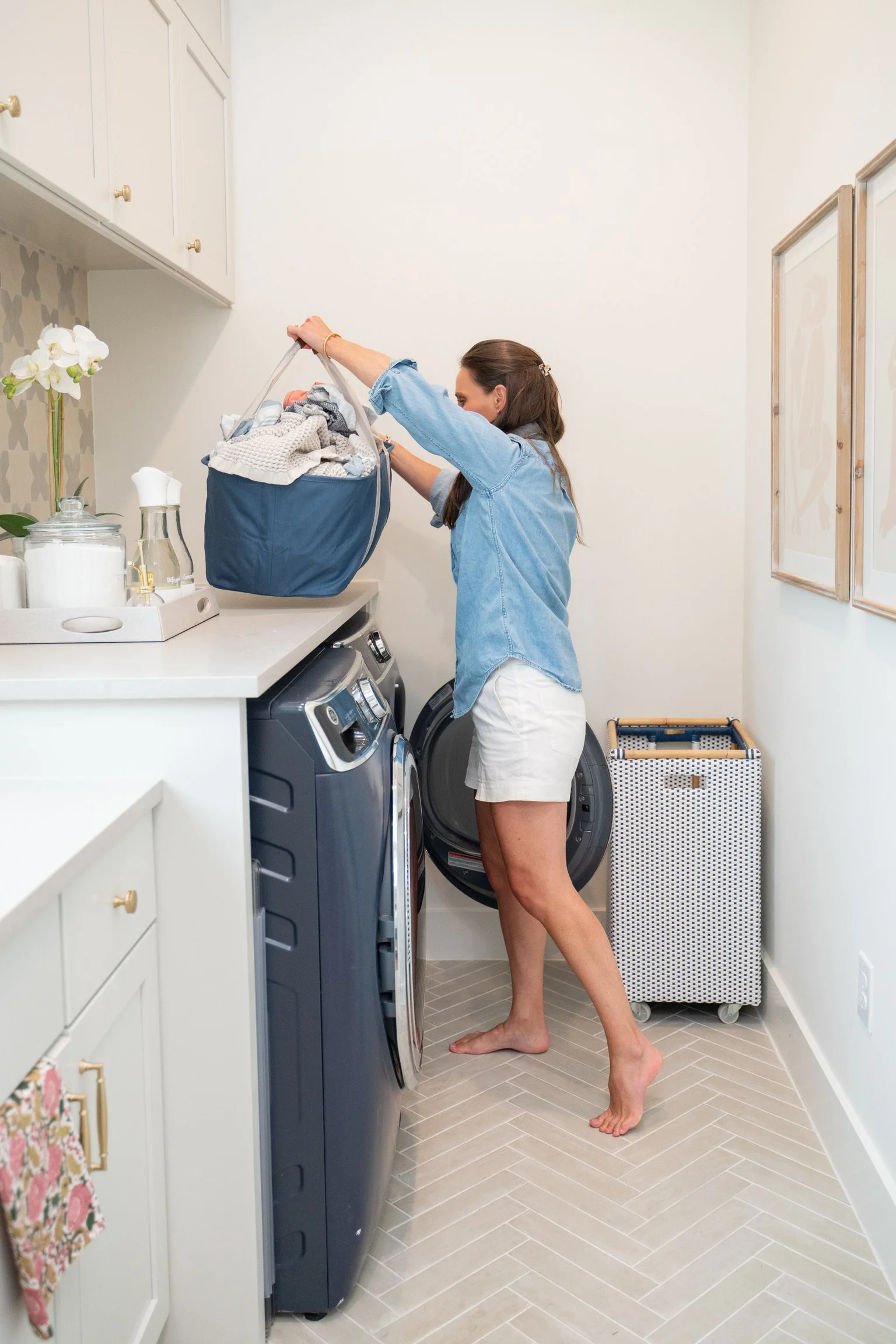
I have a test for whether a laundry room is truly organized: Can everyone in your home use it without asking you where things are, and after a full week of real life, can you reset the entire room in 30 minutes or less?
If the answer is no, keep reading.
Because your laundry room may look organized. It may even have beautiful baskets and matching labels. But if you’re the only person who understands the system, if the counters constantly disappear beneath piles, or if putting the room back together requires an afternoon of sorting and decision-making, the room isn’t actually working for you yet.
I believe our hardest-working household spaces should do more than hold our things. They should carry some of the mental load of running our homes. And nowhere have I seen that play out more clearly in my own life than in the laundry room. My current laundry room is beautiful, and I’m incredibly grateful for the Graceful Spaces team who organized it. But it is also used heavily. Laundry gets folded. Dogs get fed. Cleaning products get replenished. My daughters use it. My husband uses it. A pet sitter can use it.
Real life happens in there. And yet, even after a particularly busy week, I can reset the entire room in about 30 minutes. That, not whether it stays photo-ready every day, is how I know the system works. Interestingly, this philosophy didn’t begin with a beautiful laundry room.
It started with almost no laundry room at all.
Lesson One: Square Footage Matters Less Than a Space That Knows Its Job
When Graeme and I first got married, we lived in an 800-square-foot condo. Our stackable washer and dryer were tucked into what was essentially a tiny water closet. I had very little room to work with, so I used all of it: the back of the door, the space above the machines, a narrow section of wall, the floor, even magnets on the washer and dryer. I wasn't trying to create something worthy of a photograph. I needed a very small space to carry a meaningful amount of everyday life.
When we bought our first house, I had more room, but I approached it the same way. We added locker space for the girls, a butcher-block work surface over the washer and dryer, and cubbies sized specifically for our laundry baskets. It wasn't a luxury laundry room. But it functioned beautifully. And after years of organizing homes professionally, I've become even more convinced of something I was instinctively trying to accomplish back then: The rooms we use for the most ordinary parts of life often have the greatest power to make life easier.
My laundry rooms have gotten bigger and prettier over the years. The philosophy hasn't changed. Whether you're working with a laundry closet, a modest utility room, or a beautiful custom space, the same questions matter: What does this room need to accomplish? Who needs to use it? And how can the space make those things easier?
Start there. Not with the bins.
Lesson Two: Your Home Should Carry Some of the Mental Load
I think we've confused an organized-looking home with a home that is actually organized. They're not necessarily the same thing.
A beautifully labeled laundry room isn't particularly helpful if one person still has to remember where the extra detergent is, notice when the paper towels are running low, explain where the dog food belongs, and continually put everything back after everyone else. The goal isn't for one person to become exceptionally good at maintaining the house.
The goal is for the house to become easier for everyone to maintain.
At Graceful Spaces, we think a well-designed system should transfer information out of someone's head and into the physical environment. The space itself should help communicate what belongs there, where the extras live, what is running low, and how the room functions.
In other words, organization is pre-deciding.
Every useful decision we make once- where something belongs, how much we keep, who needs access to it, how it gets replenished- is one fewer decision someone has to make over and over again. And when you multiply those tiny decisions across an entire home, day after day, they become a significant amount of mental load. Good organization gives some of that capacity back.
Lesson Three: Give Every Hardworking Room a Job Description
Laundry rooms are especially prone to becoming household overflow because they're functional, often have cabinets, and conveniently have a door we can close.
Over time, things without clear homes naturally migrate there. Eventually, the room becomes responsible for laundry and cleaning, pets and returns, projects and travel supplies, and everything else we weren't quite sure what to do with. The room ends up storing a lot while functioning very little. That's why one of the first things I do when thinking about any space is decide: What is this room actually responsible for? In my own home, I generally try to limit a room to no more than three primary purposes.
My laundry room has three: Laundry. Pet care. Cleaning and household backstock. That's it. Something unrelated may temporarily land on the counter while life is happening, but it doesn't earn permanent storage simply because there happens to be an empty shelf. Available space isn't the same thing as appropriate space.
Before you reorganize your laundry room or buy a single product, give the room a job description. Once you know what belongs, deciding what doesn't becomes much easier.
Lesson Four: Make the Things You Do Constantly the Easiest Things to Do
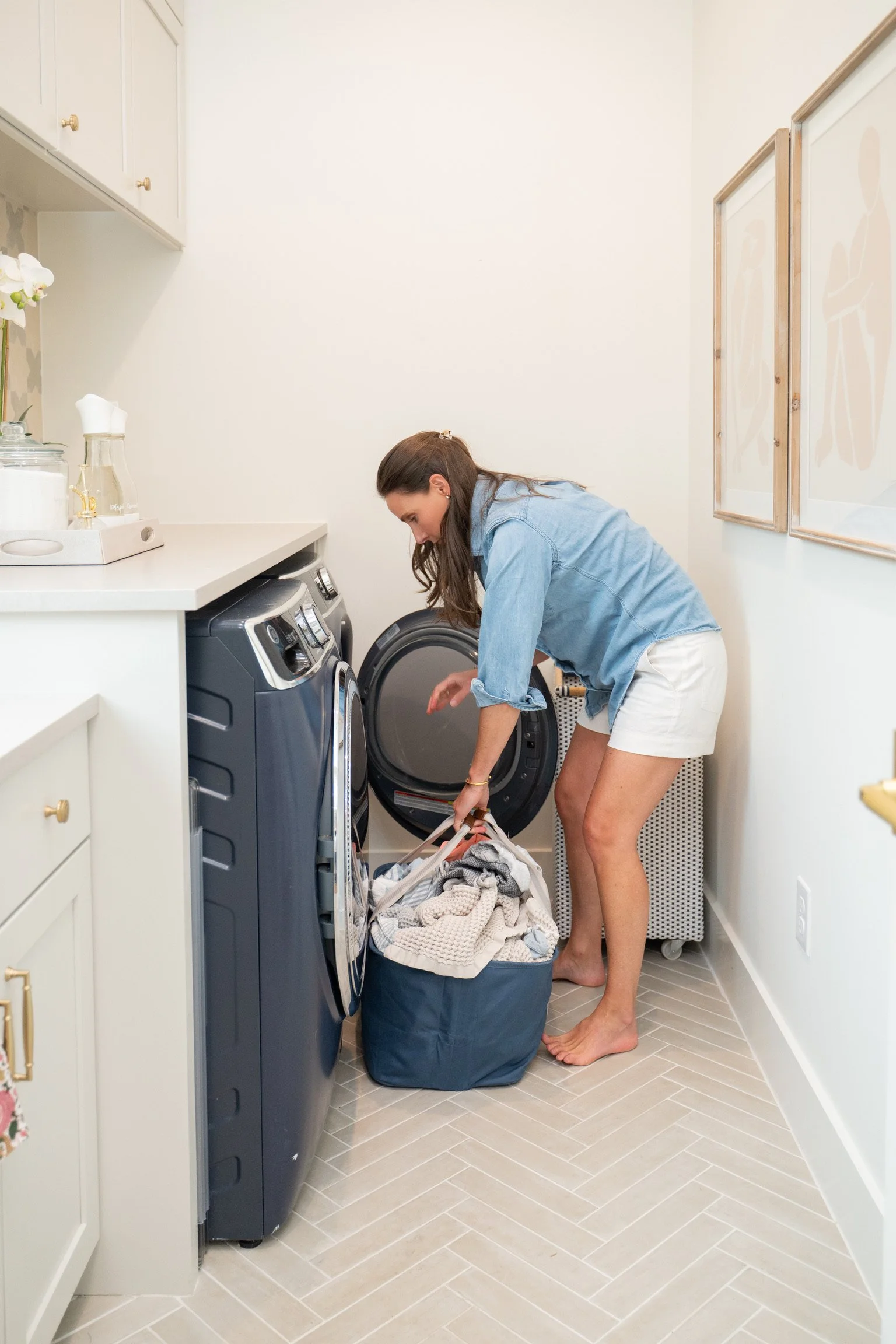
Laundry is obviously the primary job of this room, so I want the things we use constantly to require as little effort as possible. One thing I've wanted in every laundry room I've had is a work surface.
In our first house, we installed a butcher block over the machines. Today, I have a countertop. It's where laundry gets folded, but it's also where everyday household life can temporarily be processed. And I don't mind that. A hardworking room is allowed to look like it's working. The key is that everything eventually has somewhere to return.
My current laundry room also has very high cabinets. They're wonderful for storage, but they're not where I want to keep something we reach for several times a week. Instead, our everyday laundry essentials stay within reach on a beautiful tray on the countertop. I decant the products we use most often so the setup is functional while still looking calm when the room is reset.
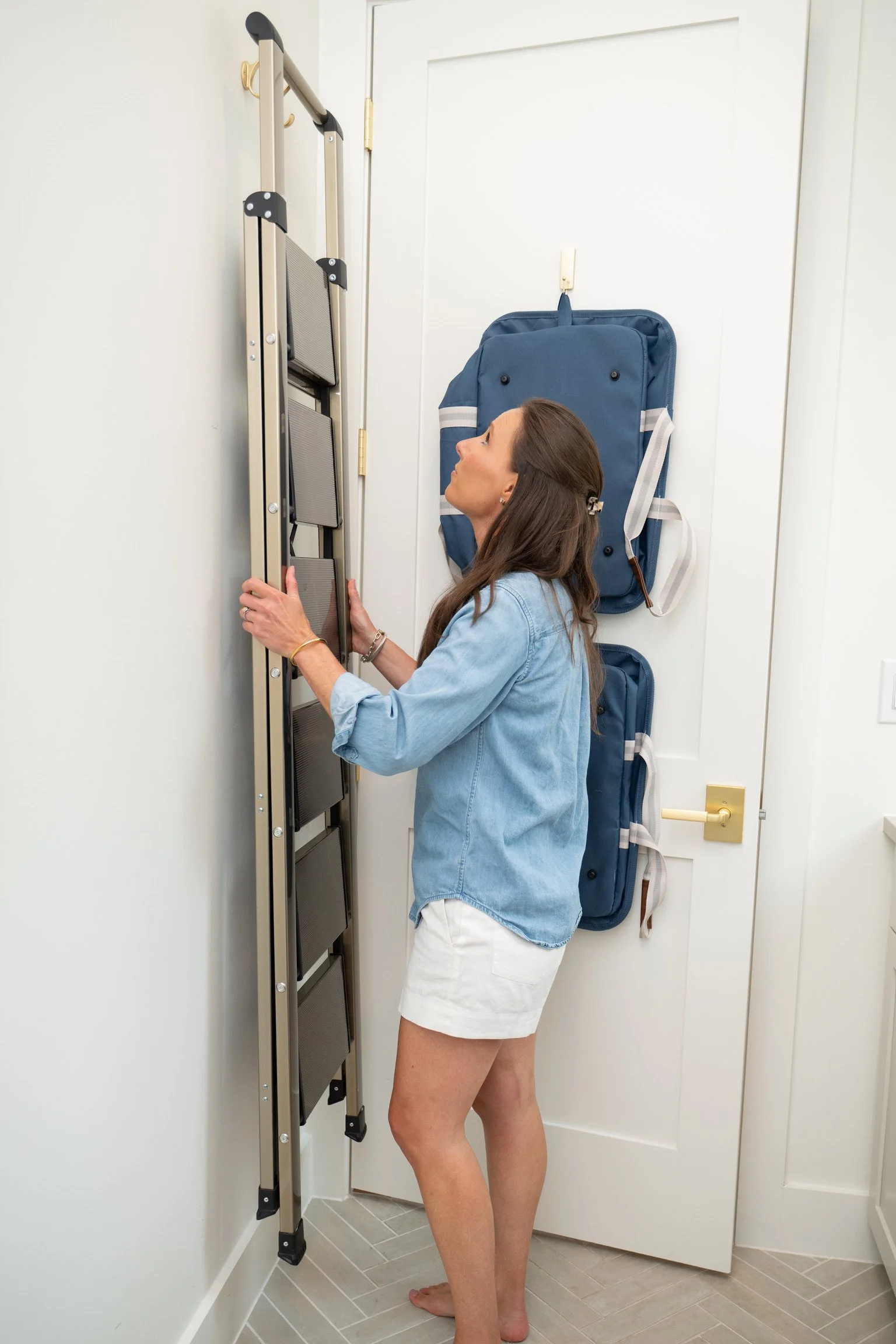
For everything stored higher up, I have an extra-tall ladder I love. For years, the attractive versions I found were incredibly expensive, so I was thrilled to find a beautiful, much more affordable option on Amazon. But even the ladder has a home. We installed beautiful gold hooks behind the door where it hangs when it's not being used.
That's a tiny example of a much larger principle: If something regularly floats around a room, it probably doesn't have a clear enough home.
Lesson Five: Solve the Friction You Experience Over and Over Again
Some of my favorite organizing solutions aren't revolutionary. They simply solve something that used to annoy me repeatedly.
I have a Serena & Lily rolling laundry basket that came with us from our Charleston house. In that house, I actually designed a little nook for it. This room doesn't have the nook, but the basket still functions beautifully, so it came with us. That's where miscellaneous laundry can collect during the week. When we're doing more laundry at once, we have two collapsible baskets hanging on Command hooks behind the laundry-room door. They take up almost no space until we need them.
I don't iron enough to justify giving valuable space to a full-size ironing board, so I use a foldable ironing mat that Rebecka introduced me to.
Simple problem. Simple solution.
We have a designated lost-sock bin, because apparently, professional organization still cannot solve one of life's great mysteries. And I keep multiple sets of dryer balls for essentially the same reason. They disappear. They come back. We've made peace with one another.
I also really dislike running out of laundry detergent, so I keep several backups in our upper cabinets. But backstock isn't permission to accumulate endlessly. It has a defined home and a defined capacity. We can see what we have, use what we have, and replenish it when it gets low.
That's the difference between being prepared and simply storing more stuff.
Lesson Six: Personalize the System Around the Way You Actually Live
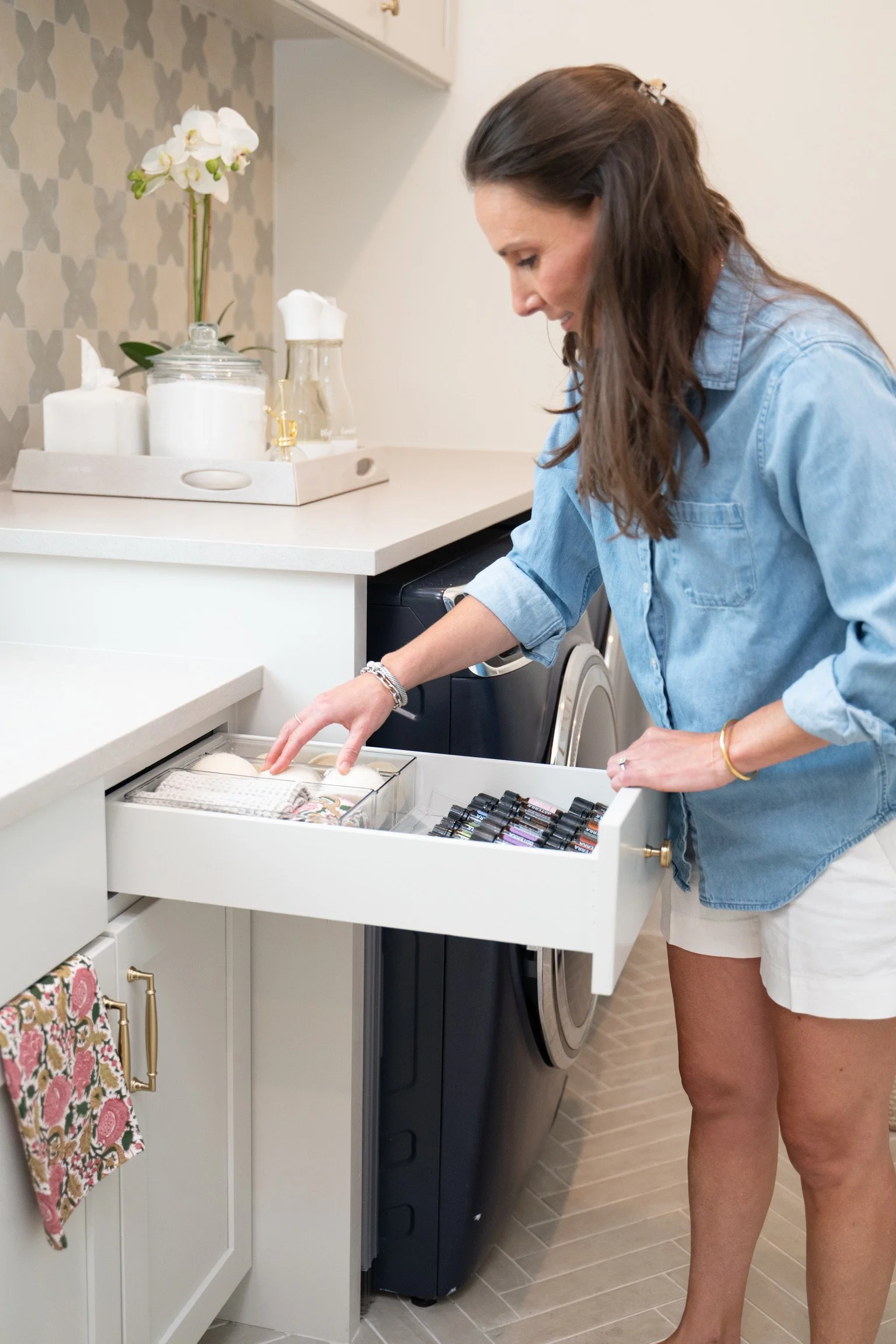
One of my favorite drawers in this room holds essential oils. I love using them with our dryer balls, and I care a lot about reducing toxins where it makes sense for our family. Before this drawer existed, those little bottles were exactly the kind of category that could end up tucked into several different places. Now they're together. I can see what I have. I actually use them. And the dryer balls aren't wandering around the room. It's a small thing, but those are often the details that make a space feel truly personal.
Your laundry room doesn't need an essential-oil drawer because mine has one. It needs solutions for the things your family actually does.
If reducing toxins in your home is something you're interested in, this is also something the Graceful Spaces team can incorporate into an organizing project through Purely Organized.
I personally use products like Branch Basics throughout our home, so we'll also link the laundry and cleaning products I actually use.
Lesson Seven: If Only One Person Can Use the System, It Isn't a Household System
This may be the most important thing about my laundry room: I am not the only person who uses it. My girls are 12 and 13, and they've been doing their own laundry for years. Do they perfectly file-fold everything? No, and that's okay. Because perfect folding isn't actually what I'm trying to teach them.
I want them to know how to take care of their belongings. I want them to understand that a responsibility has multiple steps. I want them to learn to start something, follow it through, and finish it. And I want them to learn time management. We use Skylight to help the girls manage their responsibilities and the different steps involved in household tasks.
If Sunday evening arrives after you've spent the day with friends and you suddenly remember you haven't done your laundry, Monday is still coming. The washing machine takes however long the washing machine takes. The dryer does too. That's not punishment. That's life. I'd much rather my girls practice managing those realities now, in a home where they're loved and supported, than discover them for the first time when they're living on their own.
An organized home shouldn't just serve our children. It should help prepare them to eventually run lives of their own.
That matters far more to me than a perfect drawer.
Lesson Eight: Good Systems Create Shared Ownership, Not Dependence
And then there's Graeme. Graeme handles the household laundry for the two of us. This is both an enormous act of love from him and something that initially required an unexpected amount of personal growth from me.
It turns out two married adults can have surprisingly strong opinions about the correct way to do laundry. There may have been a few conversations that went something like: "I understand what you're saying." "Yes, but that's not actually what I said." "I respectfully disagree." Marriage is beautiful.
Eventually, I had to decide whether I wanted the laundry done exactly my way or whether I wanted to stop being the person responsible for all of the laundry. Grace prevailed. And Graeme does an incredible job. But there's an important organizing lesson underneath our marital laundry negotiations: A well-designed system makes shared ownership possible.
If I create such a specific system that only I can execute correctly, I haven't created freedom. I've created another job for myself. Graeme knows where everything is. The girls know where everything is. Someone helping in our home can understand the system. The room isn't dependent on me. That's Effortless Living.
Lesson Nine: Make Everyday Care Easy Enough That Someone Else Can Step In
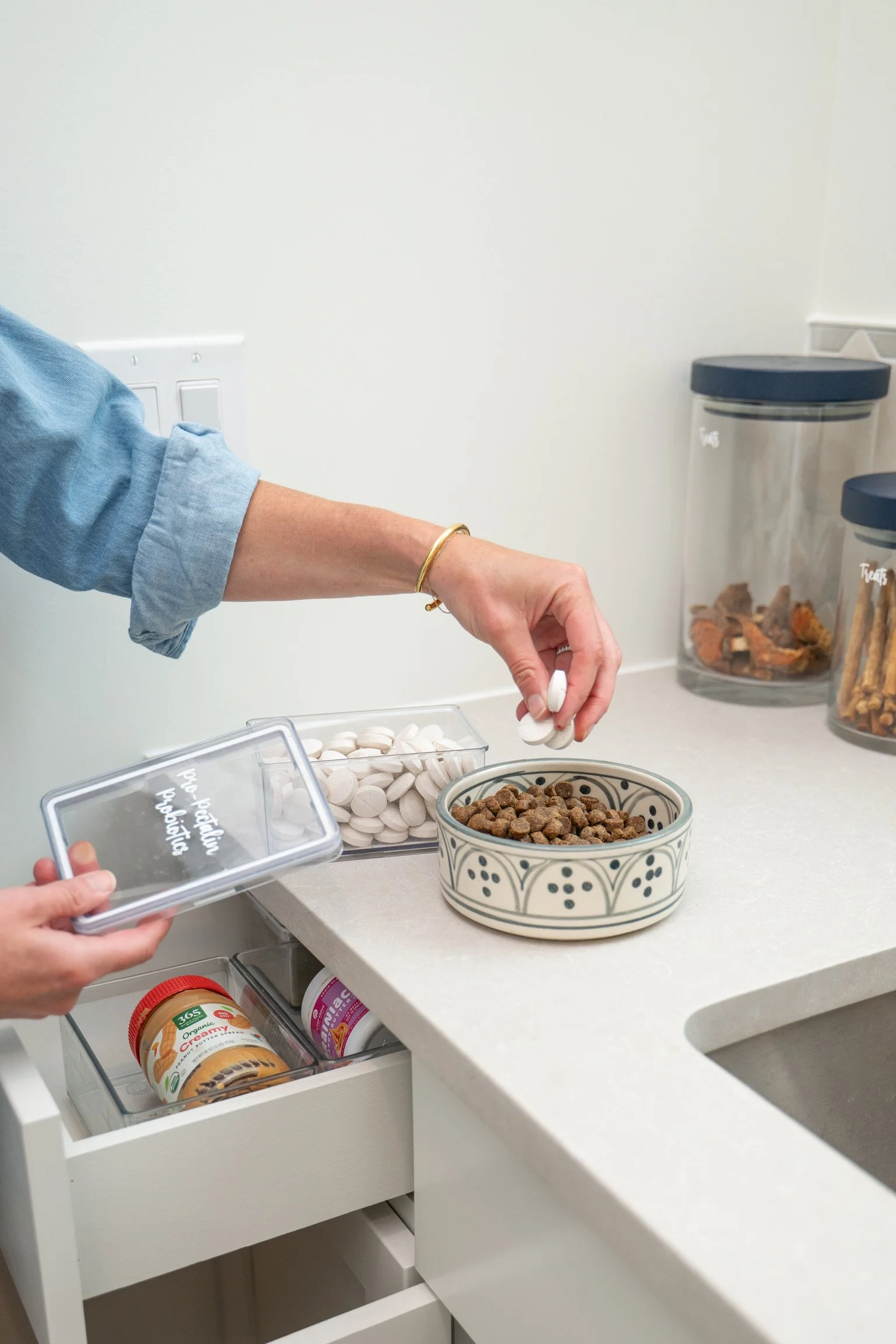
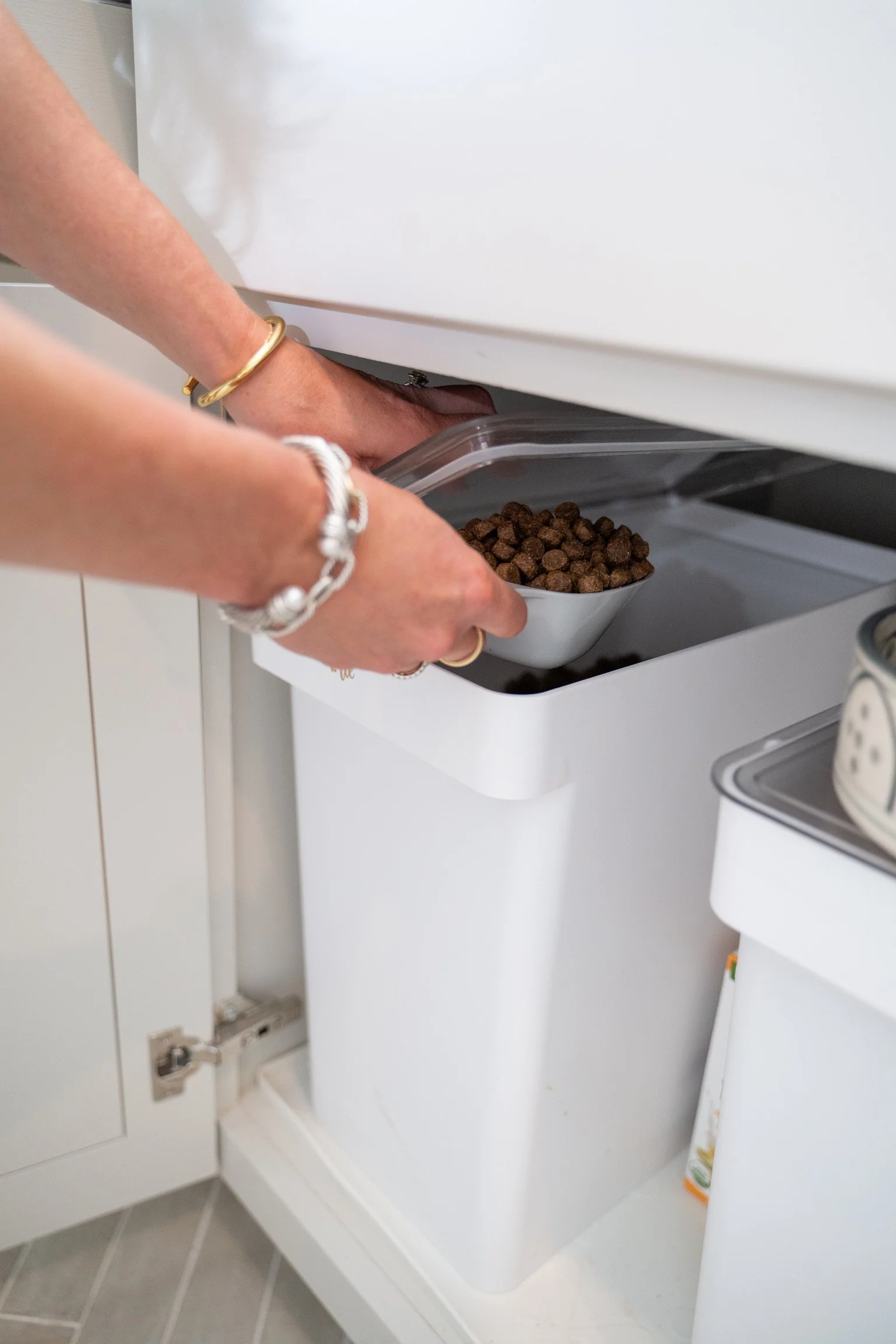
With three pets, pet care is not a tiny category in our household. It is an operation. One of my biggest questions when we moved into this house was where we were going to store the dog food. Large bags are bulky, heavy, and not exactly what I wanted sitting in the middle of the laundry room.
The Graceful Spaces team found containers that fit perfectly underneath our sink and hold an entire bag of dog food. I cannot adequately explain how happy this solution made me. Of all the products our team sourced for this house, this may genuinely be one of my favorite wins. The container fits the space. The entire bag fits inside. There's a scoop. Everyone can access it. And a pet sitter can walk into the room and understand what to do without calling me.
Because Mr. Cheddars has already demonstrated his ability to flood our house, we also have a protective mat underneath the sink. We have developed a healthy respect for water protection. The rest of the pet zone follows the same philosophy: everyday care should be obvious and accessible to the people responsible for doing it. The system transfers information out of my brain and into the environment.
Lesson Ten: Deep Storage Needs More Structure, Not More Stuff
Deep upper cabinets can be wonderful. They can also become places where things disappear for a decade. The deeper and less accessible the storage, the more important it is to give it structure. Our team used really simple deep bins to create defined categories for cleaning products and household backstock. Paper towels have a defined space. Cleaning refills have a space. Branch Basics concentrate, and our other supplies have their own categories. It isn't complicated. It's clear. And in an organizing system, clear almost always beats clever.
Labels aren't just decoration. They're communication.
Our cabinets are professionally labeled with custom vinyl, including labels inside the doors where they're useful. Obviously, I appreciate a beautiful label. But the label's real job is much more practical. It communicates. Someone can see where paper towels belong and notice when they're getting low. A space doesn't become permission to put something unrelated there. Someone other than me can put things away correctly. Again, the home carries a little more of the information. And I carry a little less.
If you want to create this yourself, we have a complimentary Luxe Label Guide that walks you through creating beautiful custom vinyl labels at home.
The Biggest Lesson: Don't Organize for Perfection. Organize for Reset.
This is the principle I most want you to take away from my laundry room. My laundry room gets messy. Of course it does. It's supposed to. Laundry gets folded. Supplies arrive. The girls use it. We're in the middle of projects. We're hosting. We're caring for animals. Real life moves through this room every day. I don't judge whether an organizational system works by whether the room stays perfectly tidy. I judge it by how easily the room can recover. After a particularly busy stretch, I can walk into this laundry room and reset the whole thing in about 30 minutes. That's possible because I'm not standing there making 50 new decisions. Most of them were made when we created the system.
I know what belongs in the room. The backstock has a home. The ladder has a home. The baskets have homes. The dog supplies have homes. The everyday products are accessible. I'm not reorganizing. I'm resetting. There is an enormous difference. The best-organized homes aren't always tidy. They're easy to return to tidy. And I think that's a much healthier and much more useful standard for a real home.
Try This at Home: The 30-Minute Reset Test
I want you to try something. Walk into your laundry room, or another hardworking space in your home that's constantly frustrating you, and ask: If I had 30 minutes, could I return this room to baseline without making a bunch of new decisions?
Not hide everything. Do not move the clutter into another room. Actually put things where they belong. If you can, you probably have a functioning system that simply needs a reset. But if most of those 30 minutes would be spent trying to figure out where things belong, whether you still need them, who owns them, or why they're in the room in the first place, you probably don't have a reset problem. You have a system problem. And that is actually good information. Because now you know what needs to change.
Start With One Small Win
Please don't leave this article thinking you need to renovate your laundry room. Remember where I started. An 800-square-foot condo. A stackable washer and dryer. A tiny section of wall. Magnets on the machines. You can start today without buying anything. Give your laundry room a clear job description. Remove what doesn't support those jobs. Clear one useful work surface. Then pay attention to the friction.
What annoys you every single week? Maybe the detergent is difficult to reach. Maybe no one knows where the extra supplies are. Maybe the laundry baskets don't have homes. Maybe pet food is constantly in the way. Solve one recurring problem. Then live with the solution. Good organization is rarely one enormous transformation. It's a series of thoughtful decisions that remove unnecessary friction from the things we do over and over again.
This Is What We Mean by Effortless Living
I don't need my laundry room to look beautiful every minute of the day. I need it to work. I need my daughters to be able to walk into it and take ownership of their clothes. I need Graeme to be able to do laundry without asking me where something is. I need a pet sitter to feed our animals. I need someone to notice we're running low on paper towels and understand where the extras belong. I need the room to carry real life. And then, after a particularly full week, I need to be able to spend 30 minutes putting everything back where it belongs and watch the room return to itself.
That's what an organized home should do. It shouldn't stay perfect. It should recover easily. It shouldn't depend on one person. It should empower everyone who lives there. It shouldn't simply contain our things. It should carry some of the weight of our lives. That's what we mean at Graceful Spaces when we talk about Effortless Living. It doesn't mean eliminating the work of life. Laundry still has to happen. Dogs still need to eat. Children still need to learn responsibility. Supplies still run out. Homes still get messy. We're not trying to organize away life.
We're removing unnecessary friction so we have more capacity for the life happening around us. And that, to me, is what makes a beautifully organized home actually beautiful.
Ready to Make Your Laundry Room Work Harder?
You can take this as far as you want.
If you want a simple weekend win, start with the 30-Minute Reset Test and download our free Luxe Label Guide to make your storage easier for everyone in your household to understand.
If you want to borrow some of the solutions that are working in my home, we've gathered my laundry, cleaning, and pet favorites in one place, from the dog-food containers I am perhaps disproportionately excited about to the baskets, ladder, dryer balls, cleaning products, and everyday tools we actually use.
And if you're looking around your home thinking, I don't need another basket. I need someone to figure out how all of this should actually work; that's exactly where the Graceful Spaces team shines. Our job isn't simply to put your things into beautiful containers. We look at how your household operates: who's using each space, where responsibilities live, what needs to be accessible, what needs to move in and out, where you're repeatedly experiencing friction, and what information you're carrying in your head that your home could be carrying for you. Then we create systems around the way you actually live.
And before you go, I want to hear from you. What's the one thing about your laundry room that drives you crazy every single week? Or, if yours is already working beautifully, tell us the one system you swear by.
Share it in the comments, and don't be shy. I want Graceful Living to be a place where we're learning from one another, not simply showing you what's working in my home. Because the goal was never a house that looks like nobody lives there. It's a home that makes it easier for everyone who lives there to live well.
Graceful Living is where we share the things that make life feel a little more intentional and a lot more beautiful. From thoughtful ways of living and everyday rituals to style inspiration, favorite recipes, travel moments, and the small joys that elevate the ordinary... this space is meant to inspire a life well lived.
If you love content that feels calm, curated, and life-giving, I’d love for you to be part of our inner circle.
By joining our Graceful Living subscriber list, you’ll receive our newest posts straight to your inbox, so you never miss a story, idea, or inspiration we share: thoughtful living, elevated everyday moments, style, recipes, travel, and joy, beautifully woven together.
Click the link below to subscribe and make sure you’re receiving our Graceful Living emails. I can’t wait to share more with you.

The Things We Use Every Day
And if you’d like to follow along with what Rebecka and I genuinely love, we’ve created shop pages that bring all of our favorites into one place. A simple way to explore what we consistently reach for in our own homes, whether you’re looking for inspiration or ready to try something new.
follow us on shop my
follow us on ltk
More Inspiration
Our Charleston Home Organization Our Purely Organized Service GS Top 5 Pantries Meet Our Team More From Graceful Living