
The Thoughtful Nighttime Reset: A Conversation with Rebecka

A few weeks ago, we talked about margin, the space that has to be built into a life on purpose, because it never shows up on its own. September tends to close that space in fast. The school year has just found its footing, the calendar is filling back in, and the holidays are already visible on the horizon. This is usually where people start running on empty before they've even noticed it happening.
Margin isn't just about protecting a home. It's about protecting the person running it. And nowhere is that more visible than in the hour before bed, the last stretch of the day, when what happens, or doesn't, quietly decides how the next morning goes.
Margin like that doesn't happen by accident, and Rebecka is one of the truly intentional people we know when it comes to building it. So we asked her what her evenings actually look like, and how that margin gets protected once the day is technically over.
At 7 p.m., no one in Rebecka’s house is thinking about tomorrow morning. That’s the point. The dishwasher is running. Backpacks are hung up. Lunch bags are where they belong. Everyone knows what they’re responsible for, and the things that need to happen before bed don’t require a conversation every night.
Rebecka is one of the most intentional people we know when it comes to creating a home that works this way. Her approach isn’t about rigid routines or having a perfectly organized house. It’s about making decisions once, creating systems around them, and gradually giving everyone in the household ownership.
We sat down with her to talk about what that actually looks like in her home, and how those systems have evolved as her daughters have grown.
What are two or three things you do each evening that make the next morning feel easier or more organized? What are your nonnegotiables?
Rebecka: Staying in our routine as a family is a nonnegotiable. Whether the dishwasher is full, half full, or only 25% full, it gets turned on every night. If it doesn’t, the morning routine of whoever is in charge of unloading it gets thrown off. The girls also have a designated area in the mudroom where everything gets put away by the end of the night: water bottles, lunch bags, charged computers, and backpacks. If that doesn’t happen, the next morning feels chaotic.
So really, the nonnegotiable is that everything on the checklist for that day actually gets checked off. Otherwise, we spiral a little the next day.
A Graceful Spaces takeaway: The best family systems don’t need to be complicated. They need to be clear enough that everyone knows what needs to happen, where things belong, and who owns them.
If you’re working on creating more intentional systems in your own home, our Household Huddle Checklist is a good place to start. It can help your family identify recurring responsibilities that need an owner rather than living entirely in one person’s head.
What does your family’s evening reset actually look like once everyone is home from school and work?
Rebecka: It looks a little different depending on the girls’ activity schedules, but the core is that each person owns their own tasks. Everyone knows their items need to be put away and their rooms need to be in order, and everyone knows their job around dinner. The girls typically do the dishes afterward, Tom walks the dog, and I usually make dinner, which also lets me make sure the house is put together after my workday.
Throughout the evening, everything gets put into its home, its bin, or its hamper. Once that’s done, everyone feels set up for the next day.
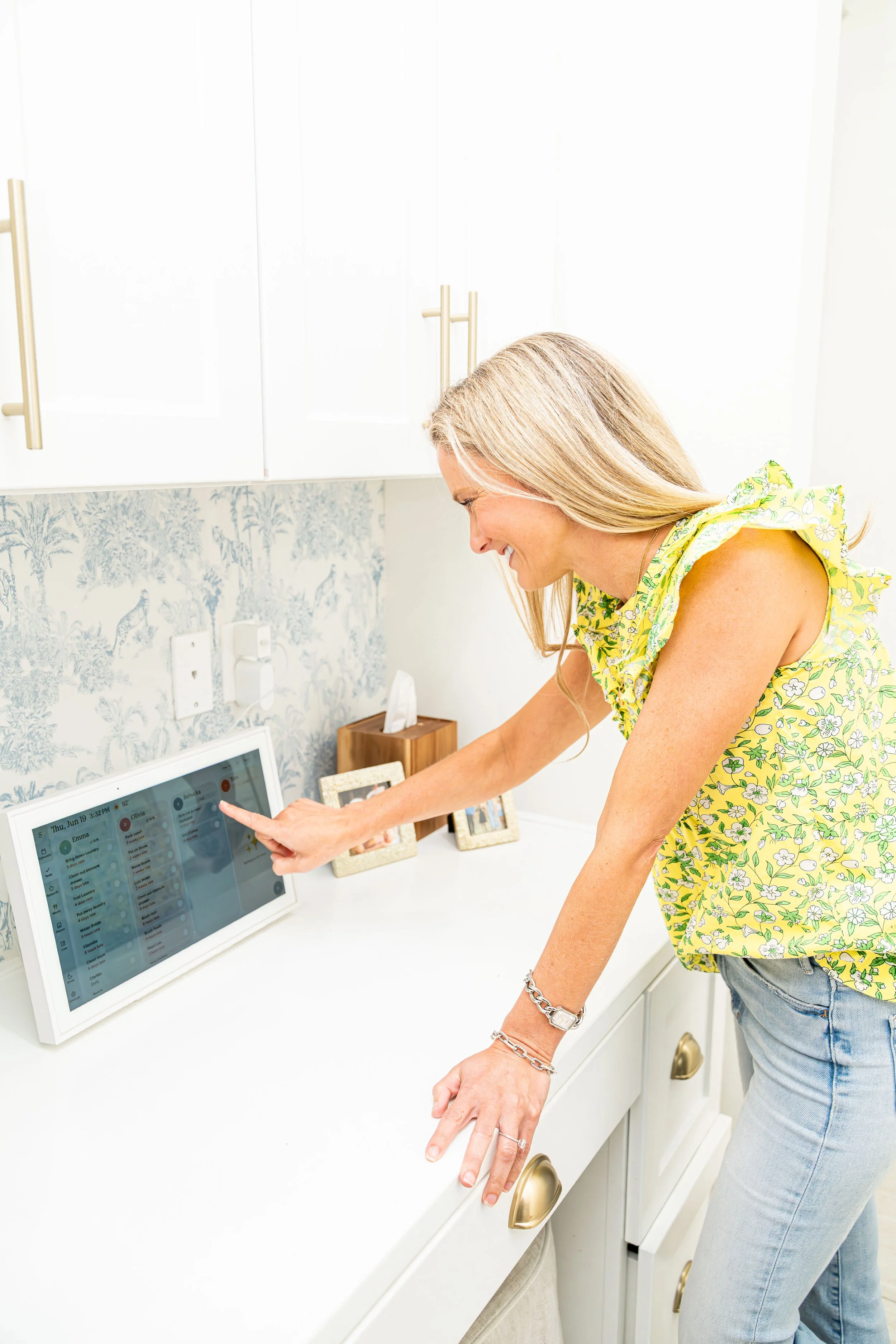
The Skylight Calendar has also been a game changer for our family. Having everyone’s schedules, activities, and responsibilities in one place means the girls can see what’s coming and take more ownership of their days. It’s one less thing I have to keep track of for everyone, and it has made a big difference in helping our evenings and our mornings run more smoothly.
What responsibility do your girls have in the evening to help prepare for the next day?
Rebecka: Both girls are responsible for doing the dishes every night after dinner. It’s become a nice reset time for them where they get to laugh and connect while doing something independently. After that, they get ready for bed, and at the very end of the night, all four of us come together for nightly prayers, which is a great way to close out the day and prepare for the next one.
Laundry works differently since it’s hard to keep up with during the week. All laundry gets washed on Saturday, and every Sunday, my oldest, Emma, folds it for everyone into individual baskets. Everyone puts their own away by the end of the day on Sunday.
This fall, Emma also took on walking our neighbor’s dog every morning. Our neighbor is dealing with an illness and can’t do it herself. It’s been a great responsibility for her because it means she has to get up earlier and think through her homework the night before. Her mornings now have to be planned in five-minute increments, and she’s really taken to having everything dialed in.
We’ve also set things up so the girls get ready upstairs but keep everything else they need downstairs, extra toothbrushes, deodorant, and things like that, so they’re not running up and down.
And since my youngest, Olivia, joined the cheer team, we created a designated spot in the mudroom for all of her cheer outfits, uniforms, and pom-poms. We realized they would otherwise get tangled up with her everyday closet. One of her daily Skylight checklist items is, “Do I need anything for cheer today?” That means I don’t have to be the one reminding her. It’s just part of her own routine.
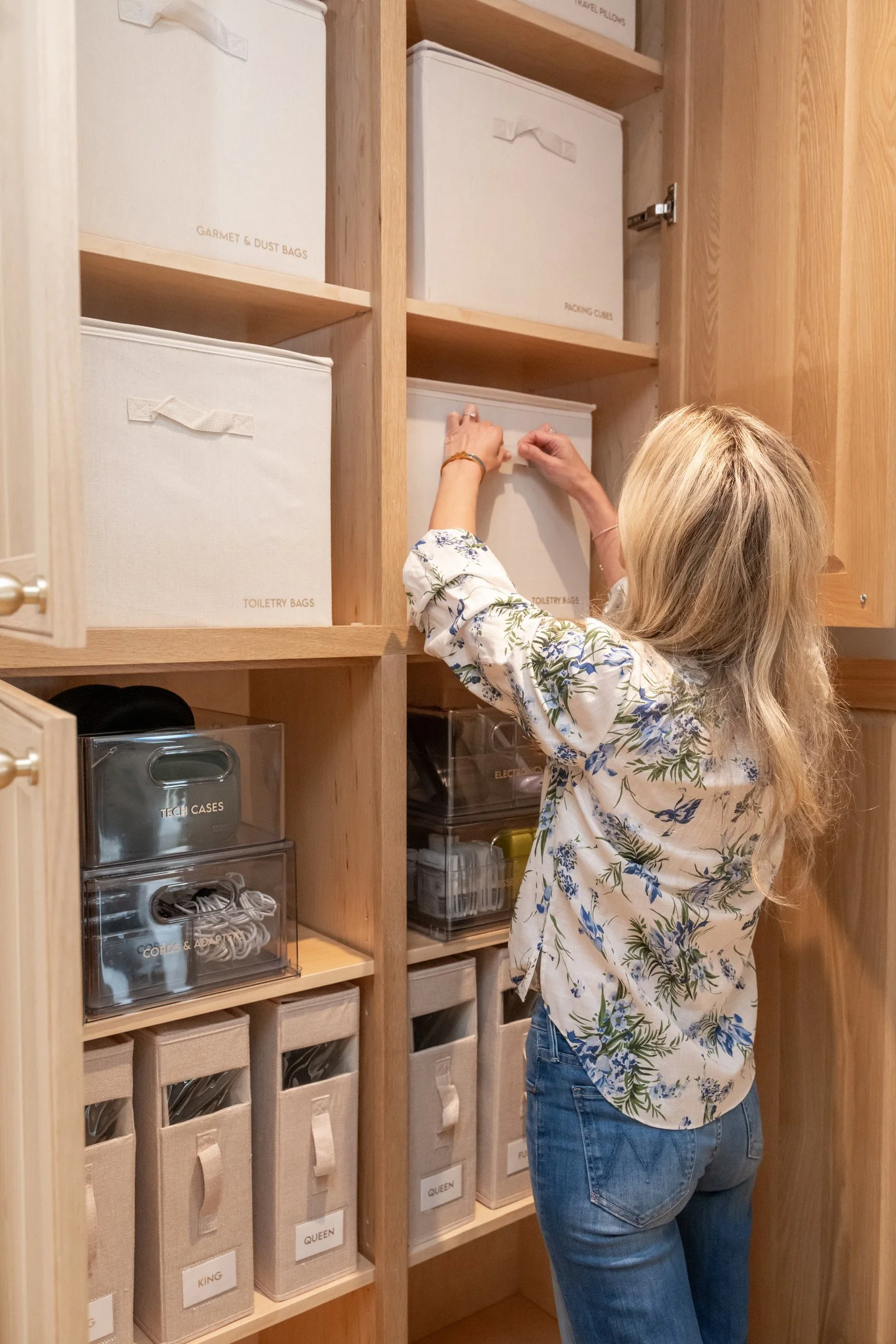
A Graceful Spaces takeaway: Pay attention to where your family is experiencing unnecessary friction. If someone is constantly running upstairs for something, create a home for it closer to where it’s actually being used. If an activity has its own gear, give that gear a designated space.
Good organization isn’t always about adding a system. Sometimes it’s about putting the right thing in the right place. This is the same thinking behind the zones every family needs: a spot for everything that moves in and out of your day.
How have your family’s evening routines and responsibilities evolved as the girls have gotten older?
Rebecka: I used to make their lunches every morning, get their water bottles ready, do their hair, feed the dog, a lot of things. At that stage, just getting dressed and doing the basics was worth celebrating. But every year they take on a new routine or responsibility. Now they get themselves ready, make their own lunches and breakfast, and are pretty much self-sufficient in the morning.
That’s given us the chance to enjoy something different together instead: family devotional time, where they use their Jesus Calling, and I do my own devotional. It’s nice that our time together in the morning is quality time now instead of task-related.
Have there been moments where you’ve intentionally stepped back and given them ownership?
Rebecka: Absolutely. My oldest genuinely enjoys having an organized room and resets it on her own every day. My youngest is still in a phase where she has about 50 Jellycats that she likes moving around her room. Rather than expecting her to reset it every single night, I’ve let her decide when during the week she does it.
Whether it’s once or twice a week, she makes sure everything has its home. But it still feels creative and fun to her, and she really enjoys having that control over it. This kind of age-appropriate ownership is exactly what we mean when we talk about building systems that grow with your child.
What do you notice you have more of once evening systems are running well? What do you do with that?
Rebecka: When the systems are running the way I want, I shift from an “I have to” mindset to an “I get to” mindset. Helping someone out or making dinner feels like a choice, not an obligation. When systems break down, or someone isn’t doing their part, I slip into more of a victim mentality: “I have to”, and I have less patience and thoughtfulness, because we’ve put time into building the system and it’s not being used, which creates chaos.
When I know people are keeping up their part, I have more patience and more grace; I can say “this is just a busy season” or “something unexpected came up.” That margin also gives me more time to decompress after the day, be present with my family, and build a better nightly routine.

Summer 2026 in Sweden! Rebecka and her family welcomed Christina and her family to their family home. If you didn’t know, Rebecka is from Sweden, so this was such a special trip for both families. Evening routines looked a little different here than they do at home, but sharing this time was such a delight. :)
Going into a busier stretch like the holidays, does anything get protected more intentionally, or does something usually have to give?
Rebecka: Usually something has to give. I have a “Saturday checklist” of things I genuinely enjoy: watering plants, blowing out the garage, ironing. In busier seasons I don’t cut those out entirely; I scale back. Maybe I iron once every two to three weeks instead of weekly, or we use paper plates on Fridays and Saturdays because I know time is tight.
Small adjustments add up to bigger time saved. I don’t cut one big thing; I reduce lots of small things by about 10%, so it doesn’t feel overwhelming to catch back up once things settle down.

What would you tell another mom who feels like she has no margin left by the end of the day?
Rebecka: If she tried her best that day and loved well, that’s a win, full stop. But if she wants something tactical: look at what can be delegated, automated (auto-ship orders, AI help), or shared with people around her- a carpool, other family members pitching in.
The big message is that she doesn’t have to carry it all alone. That’s what I love about organization; it builds systems that let everyone in the family feel like part of something bigger than just themselves.
What We Love About Rebecka’s Approach
What stands out about Rebecka’s approach is that none of these systems are about creating a picture-perfect home. They’re about ownership, predictability, and reducing friction. The girls know where their things go. They know what they’re responsible for. The family knows what needs to happen before the day ends. And as the girls have gotten older, Rebecka has intentionally handed more of that responsibility over to them. That’s an important distinction.
An organized home isn’t one where one person keeps everything running behind the scenes. It’s one where the systems make it possible for everyone to participate.
A few of the systems from Rebecka’s home are worth borrowing:
Give everyday items a designated landing zone.
Assign responsibilities based on age and ability.
Build recurring tasks into an existing routine rather than relying on reminders.
Give children ownership of the outcome while allowing some flexibility in how they get there.
Create designated spaces for activities that have their own equipment or gear.
Move frequently used items closer to where they’re actually needed.
Use a checklist for recurring responsibilities so the parent isn’t the one carrying the mental load.
Revisit responsibilities as your children grow. What you handle for them at one age may be something they can own completely a year or two later.
The best systems change with your family.
What works for a family with young children won’t necessarily work when those children become teenagers. The point isn’t to create a routine that never changes. It’s to build enough structure that your home can change with you.
Meet Rebecka
Much of what we believe about an organized home can be traced back to the way Rebecka has always thought about space.
As a co-founder of Graceful Spaces, she helped shape the methods, standards, and level of intentionality that define our work today. She has always looked beyond the immediate solution, beyond putting something away or making a space look pulled together, to ask a bigger question: How should this home work for the people who live in it?
That thinking is foundational to Graceful Spaces. It’s why we don’t believe organization is one-size-fits-all. It’s why we look at how a family moves through a home, what creates friction, what needs to be accessible, what can be consolidated, and what deserves a more thoughtful solution. And it’s why our work is ultimately about creating systems that hold up to real life, not just systems that look good on the day we leave.
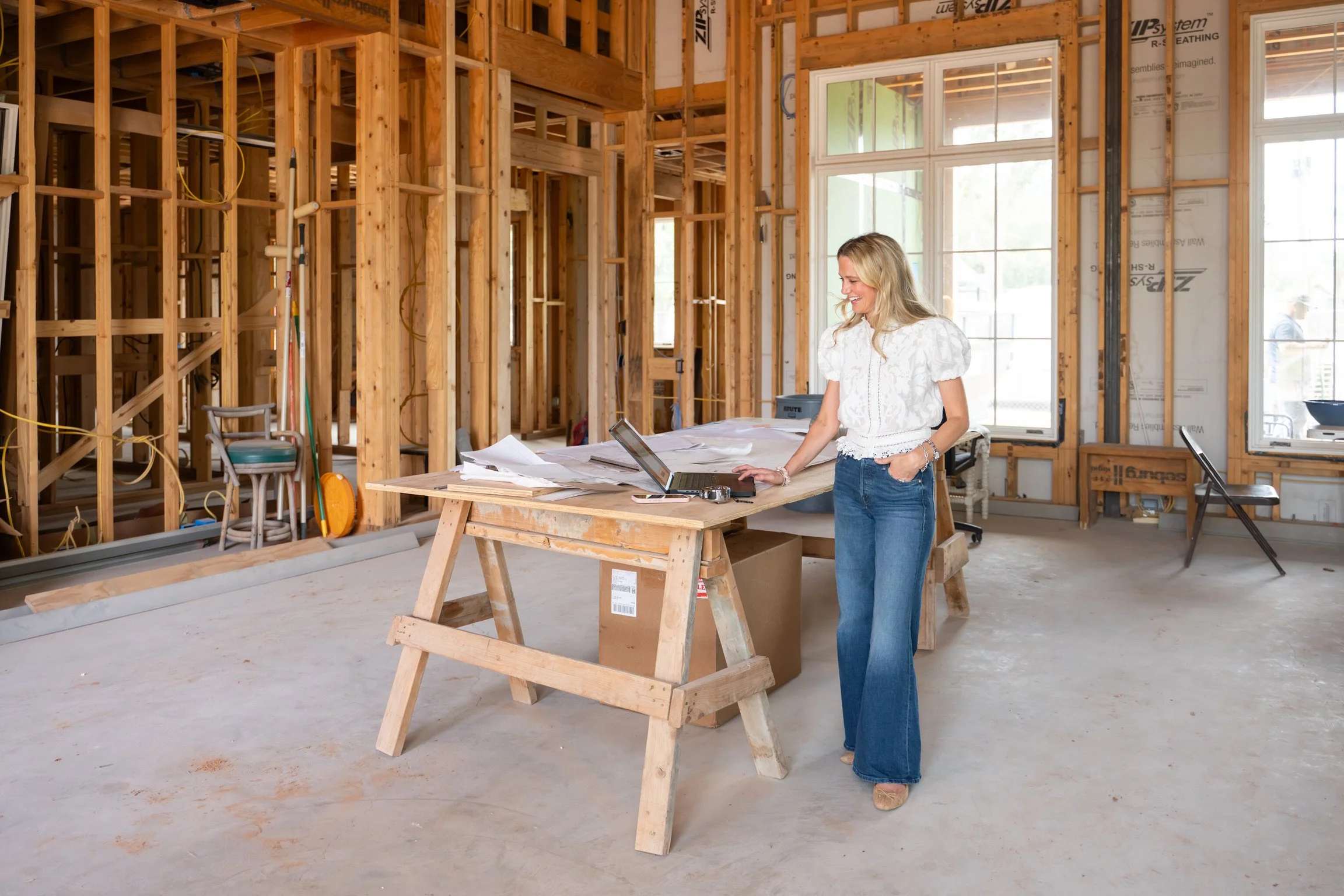
That perspective extends well beyond organizing. For clients building or renovating, Rebecka brings this same philosophy into Building Luxury, helping shape the organizational and functional details of a home before they’re built into the walls.
If you’re building or renovating a home and want to think beyond finishes and floor plans to how your home will actually function once you live in it, Building Luxury brings that perspective into the process from the very beginning.
Graceful Living is where we share the things that make life feel a little more intentional and a lot more beautiful. From thoughtful ways of living and everyday rituals to style inspiration, favorite recipes, travel moments, and the small joys that elevate the ordinary... this space is meant to inspire a life well lived.
If you love content that feels calm, curated, and life-giving, I’d love for you to be part of our inner circle.
By joining our Graceful Living subscriber list, you’ll receive our newest posts straight to your inbox, so you never miss a story, idea, or inspiration we share: thoughtful living, elevated everyday moments, style, recipes, travel, and joy, beautifully woven together.
Click the link below to subscribe and make sure you’re receiving our Graceful Living emails. I can’t wait to share more with you.

The Things We Use Every Day
And if you’d like to follow along with what Rebecka and I genuinely love, we’ve created shop pages that bring all of our favorites into one place. A simple way to explore what we consistently reach for in our own homes, whether you’re looking for inspiration or ready to try something new.